









How Unemployed Graduates Transformed a Scrap Cart into a Campus Power Hub
Author: Sipokazi Fokazi, Institutional Advancement
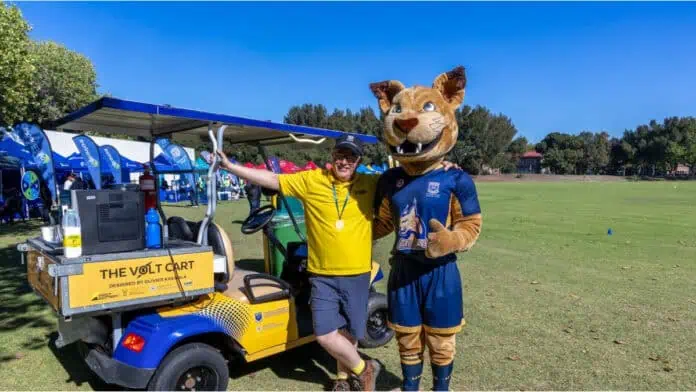
It was 18 years old, rusted and beyond repair. Today, just over a year after it shut down, the University of the Western Cape’s golf cart is the first to run on renewable energy and is back on the road as a campus shuttle.
It has been transformed into a bright yellow mobile powerhouse capable of running most household appliances – thanks to a major revamp by unemployed engineering graduates from UWC’s Energy Storage Innovation Lab (ESIL). The lab, part of the South African Institute for Advanced Materials Chemistry (SAIAMC), supports South Africa’s renewable energy transition and develops advanced lithium-ion battery technology. It is the only facility in Sub-Saharan Africa with cell assembly capabilities, and has been developing battery assembly processes since 2011.
While at first glance, the cart, dubbed “The Volt Cart”, retains a familiar profile of a traditional golf buggy. But a closer look reveals its cutting-edge upgrades. A sleek lithium-based battery unit is now mounted at the rear of the cart, replacing the older, less efficient lead-acid battery that previously powered the cart. The new battery technology delivers longer operating times of up to 140km range on a single charge. It offers faster charging times and a much longer lifespan than conventional lead-acid batteries. Other standout features include an onboard inverter and solar roof panels that provide additional power.
Prof Bernard Bladergroen leads the innovation lab that trains electrical and mechanical engineering graduates on integration of renewable energy for a year through a partnership between UWC, the Department of Science and Technology and battery manufacturer First Battery. He recalled receiving a call from the Dean of Natural Sciences, Prof David Holgate, who inquired about what could be done with a disused golf cart.
Prof Bladergroen turned to his trainees, who regularly develop practical solutions for the lab’s projects. After stripping the golf cart, the trainees had to figure out how it worked and what its energy requirements were before rebuilding it with newer materials and assembling its new battery pack.
“The students had to understand how to integrate the solar PV with the battery and how the inverter operates in that scenario. So from a training perspective, it was a very nice exercise,” said Prof Bladergroen, who added that the onboard inverter sets the cart apart.
“What makes it special is that if you drive this golf cart anywhere, you actually have an AC power point available. So, if you need to make coffee in the middle of the cricket field, you just plug in your coffee machine or your kettle and you can have your drink onboard.”
Bought in the 2000s for UWC’s Postal Services, the golf cart was originally used to assist an employee, the late Rudolph Christians, who was on dialysis treatment and had mobility challenges. Over time, however, the cost of running the cart rose sharply.
“Battery replacement became unsustainably expensive as loadshedding intensified,” recalled Adrian Snell, Safety Officer in the Faculty of Natural Sciences.
Prof Bladergroen said there was a growing global demand for lithium batteries. South Africa imported around $1-billion worth of batteries in 2023 alone. This highlighted the need for more local skills.
The main engineer who worked on the golf cart upgrade, Olivier Kasikalaala, died last year, before the project was completed. His name has been added to the cart as a remembrance of his contributions to the project.
After test-driving the golf cart at the university’s staff Wellness Day this week the Rector and Vice-Chancellor, Prof Robert Balfour, expressed delight.
“It was such a nice drive. It’s so great to be driving a vehicle that runs on clean energy and you don’t have to worry about the fuel price. You’re not having to pay the extra diesel and the extra petrol hikes at the moment,” he said.