











By Ashleigh Maritz, Grant Macfarlane, Chloe Bolton, SRK Consulting
Environmental considerations have always been an integral aspect of how TSFs are designed and operated. However, the growing impact of climate change demands innovative thinking to understand and address the additional risks imposed on these structures.
Multiday rainfall events, with high intensity over a short duration are becoming more
frequent and are not accounted for in the traditional TSF design criteria. Repeated spills at dams servicing TSFs have occurred at several mining operations in the southern African region during the rainy season. Even though there was no single rainfall event greater than the 1:2-year return interval 24-hour event, two to three of these rainfall events were occurring every few days, with low but continuous rainfall in between.
Some mines have implemented daily inspections of TSFs to detect early warning signs like sloughing or potential instability. Such inspections also detect damage of revegetated areas or signs of seepage and ponding of surface water.
Although many of the early warning systems, monitoring, and response plans in place today pre-date the GISTM, many of the elements being monitored have climate-related triggers.
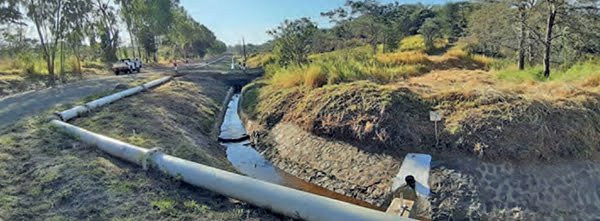
Higher rainfall events have also been addressed with redundancy, such as allowing for double the required decanting capacity of the penstock towers and outfall pipelines. Pools can therefore still be responsibly decanted in the event of heavy rainfall. The application of probabilistic analysis presents an opportunity to incorporate climate change models into various dam breach scenarios.
Water management has always been central to the responsible design and operation of TSFs. Rainfall variability is leading mine operations to consider reducing and optimising water consumption in plants and tailings production. Climate change has become an important variable, and new approaches must be implemented to account for these unprecedented changes. Climate change-related interventions enhance the adaptive capacity of mines and improve the overall resilience of TSFs.
About SRK
SRK is an independent, global network of over 45 consulting practices on six continents. Its experienced engineers and scientists work with clients in multi-disciplinary teams to deliver integrated, sustainable technical solutions across a range of sectors – mining, water, environment, infrastructure and energy. For more information, visit www.srk.co.za